How to Find Guest Post Opportunities (A Tested Step-by-Step Playbook)

What are guest post opportunities?
Guest post opportunities are websites, blogs, or publications in your niche that accept and publish articles written by outside contributors — giving you a byline, a new audience, and typically a contextual link back to your own site.
The Framework: Goal → Channel → Vet → Rank → Pitch
Set one goal before opening a search tab. It shapes every threshold you apply.
Link building
Prioritise Domain Authority and clean backlink profiles.
Referral traffic
Prioritise engaged audiences and tight topic relevance.
Portfolio building
Prioritise acceptance rate; start small.
Thought leadership
Prioritise editorial reputation and reader trust.
Steps 1–4 below cover Channel. Step 5 covers Vet. Step 7 covers Rank — an explicit scoring rule for ordering your shortlist before you pitch. Steps 8–9 cover edge cases. Keep your goal visible throughout: when a site passes some checks but fails others, your goal decides which matters most.
Step 1: Build Your Guest Post Opportunity Footprint Bank
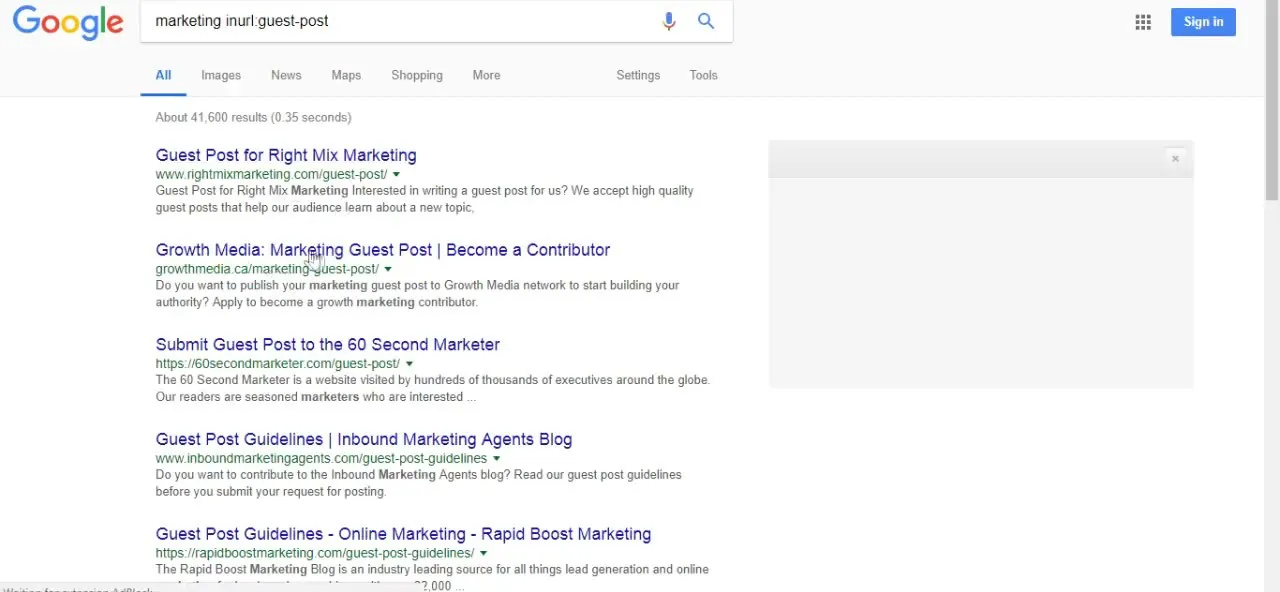
Organise operators by what they reveal, not by how familiar they look.
Open calls — sites actively seeking contributors:
| Operator | What it finds |
|---|---|
| [niche] “write for us” | Submission pages |
| [niche] “submit a guest post” | Submission pages |
| [niche] “guest post guidelines” | Guidelines pages |
| [niche] “become a contributor” | Open contributor calls |
| intitle:“write for us” [niche] | Title-level submission pages |
| inurl:write-for-us [niche] | URL-pattern submission pages |
Go to pages 2 and 3. Positions 1–3 return the most-pitched, lowest-opportunity sites; pages 2 and 3 surface usable mid-tier targets.
Contributor evidence — sites that have already published outside content, with or without a submission page:
| Operator | What it finds |
|---|---|
| [niche] “guest post by” | Published guest bylines |
| [niche] “this is a guest post by” | Published guest bylines |
| [niche] “contributed by” | External author credits |
| inurl:/guest-post/ [niche] | URL-slug evidence |
| inpostauthor:“guest post” [niche] | Author-level evidence |
Author trail — search “[Author Name]” “guest post” or “[Author Name]” “contributed to”. Every site where a prolific niche writer has a byline has already accepted outside content and has editorial standards you can benchmark.
A Warrior Forum guide on finding blogs that accept guest posting lists the author-trail method among five core techniques requiring no paid tool.
Filter vendor noise by appending -“guest posting service” -“order now” -“buy guest post” to any footprint. Without this, vendor pages and link-farm directories inflate every result set.
To browse a pre-vetted publisher list across 58 niche categories rather than building from scratch, see TheGuestPoster.com’s publisher marketplace.
Step 2: Find Guest Post Sites Without Ahrefs
A paid Ahrefs subscription is not required for competitor reverse-engineering. Use this free stack:
- Google the competitor. Run
site:competitor.com “guest post”or“[Author Name]” “contributed to”to surface their external bylines across the web. - Moz Link Explorer (free tier). Up to 10 link queries per month on a free account. Filter by dofollow, sort by Page Authority, and check referring pages for editorial bylines.
- Ahrefs Webmaster Tools (free). Adding your own domain is free and surfaces your inbound backlinks. For a competitor’s profile, a short free trial covers a targeted audit.
- Manual author search. Run
“written by [Name]”plus your niche keyword. This surfaces bylines on sites that have never published a submission page.
A BlackHatWorld thread on finding guest posting opportunities rates competitor reverse-engineering as one of the best strategies even for users who found paid tools too expensive — specifically because it proves a site has already accepted outside content.
Step 3: Uncover Hidden Guest Post Opportunities
Sites with no submission page receive far fewer pitches and often maintain higher editorial standards.
Find them:
- Search
“written by” [author name]plus your niche keyword to surface editorial bylines on sites that never advertised for contributors. - On LinkedIn, filter Posts by “accepting guest posts” or “looking for contributors.” Editors frequently post these calls in their feeds without updating their website.
- In Semrush’s free domain overview, check referring domains and look for editorial bylines in the anchor text column.
Warm up before pitching:
- Leave a substantive comment on a recent post — one that adds an example or a counterpoint.
- Share one of their pieces on LinkedIn with a brief, specific observation.
- After 5–10 days, email a concrete topic idea. Do not ask open-endedly whether they accept guest posts.
An Ahrefs tutorial on guest blogging (Sam Oh, confirmed channel) makes the point that most blogs will accept guest posts even without advertising it — a specific idea in the pitch matters far more than a submission page on the site.
A Citation Labs video (Ken McGaffin and Megan Hannay, confirmed channel) adds that personalising your approach from a specific post they have already published dramatically improves reply rates.
Need the outreach handled for you? See TheGuestPoster.com’s guest posting service or contact the team directly.
Step 4: Adjacent-Niche and Geo Rules for Guest Posting
When your exact niche returns fewer than 20 vetted prospects, expand systematically.
Go one level up
A personal-finance micro-site can pitch money-and-lifestyle blogs. Test audience overlap, not topic-label similarity — will the same reader benefit from both sites?
Go adjacent
A SaaS productivity tool can pitch project management blogs, remote-work newsletters, and small-business resource sites whose readers are plausible users.
Go geo-specific
A freelance writing coach targeting the Canadian market runs “write for us” “freelance writing” site:.ca on Google. This surfaces Canadian content blogs and national publications with active contributor calls. Adding inurl:.co.uk or inurl:.com.au applies the same logic to the UK and Australia.
Warrior Forum threads on finding niche-specific sites by geography confirm that geo operators sharply reduce result volume; when usable results drop below 10, pivot to adjacent niches or a publisher marketplace rather than stretching relevance to the point of irrelevance.
Step 5: Vet Every Guest Post Opportunity With Free Tools
Apply this six-point checklist before any site enters your pitch queue. No paid tool required.
| Check | Free tool | Pass | Drop |
|---|---|---|---|
| Domain Authority | Moz free DA checker | DA ≥ 30 | DA < 20 or trending down |
| Organic traffic signal | Semrush free overview | Any visible traffic | “No data” or flat-lining |
| Last published | Manual check | Post within 3 months | No post in 6+ months |
| Content quality | Manual read | Original, edited prose | AI padding; no named authors |
| Outbound links | Manual scan | Niche-relevant links | Casino / crypto / essay links |
| Guest-post saturation | site:domain.com “guest post by” | Some guest posts | 80 %+ of content is guest posts |
Hard red flags — drop regardless of DA: a public price list for placements, no named editor anywhere on the site, or submission guidelines that state “no editorial changes.”
A Semrush guide on guest posts identifies link farming and the absence of editorial review as the two clearest disqualifiers, and notes that legitimate publications do not sell placement spots through third-party services.
Step 6: The Beginner’s Ladder to Guest Posting
Build in order. Do not skip rungs.
Rungs 1–3 (entry)
Free publishing platforms — Medium and LinkedIn Articles — to produce linkable writing samples before you have any guest-post bylines to show. These are not substitutes for niche placements; they are proof you can write a complete piece.
Rungs 4–7 (mid-tier)
Niche blogs with DA 25–45. Acceptance rate is higher, editorial feedback helps you improve quickly, and a published byline here becomes the sample that opens the authority rung.
Rungs 8–10 (authority)
DA 50+ publications. Pitch only after 3–5 mid-tier bylines exist. Multiple Warrior Forum threads on starting guest blogging note that high-traffic publications often invite reliable contributors back once they know the writer’s voice — the ladder becomes a referral loop.
Example: a health-and-wellness writer lands a DA 34 integrative-nutrition blog first, uses that byline to approach a DA 47 fitness publication, then uses both to pitch a DA 66 wellness magazine.
Step 7: Rank Your Guest Post Prospects and Set a Stop Rule
After vetting, score each surviving site before you pitch. Use a simple priority score:
- 8–9: Pitch first.
- 5–7: Pitch after first-wave replies.
- Below 5: Drop or hold.
Track every prospect in a spreadsheet with these columns: Source | Domain | DA | Traffic signal | Last post | Niche fit | Guidelines URL | Editor contact | Topic idea | Priority score | Status
Status values: New → Reviewing → Approved → Pitched → Live / Not suitable.
Stop rule: Reach a vetted, scored shortlist of 20–30 before you begin pitching — not a 500-row dump. Pitch your top 10, review replies, then return to the list. Separating the build phase from the pitch phase prevents the context-switching that slows most outreach campaigns.
Step 8: How to Refresh a Stale Guest Post List
Pre-built lists go stale on three dimensions: DA changes, sites stop publishing, and acceptance status changes. A Quora thread on finding guest blogging sites makes the point that every list entry must be re-verified because domain authority shifts and sites quietly stop accepting posts.
For any list older than six months:
- Check the most recent post date.
- Re-run the Moz free DA check.
- Visit the guidelines page; confirm it has not become a price list.
- Verify the editor email with Hunter.io’s free Email Verifier.
Drop any site that fails two or more checks. Do not pitch it “just in case.”
Step 9: Guest Post Marketplace vs Manual Outreach
| Manual outreach | Publisher marketplace | |
|---|---|---|
| Cost | Time | Placement fee |
| Control | Full | Pre-filtered inventory |
| Vetting effort | You carry it | Marketplace pre-vets |
| Speed | Weeks per placement | Days |
| Best for | Relationships, narrow niches | Volume, time constraints |
Apply the same six-point vetting checklist to any marketplace listing before confirming it. Marketplaces reduce effort, not the need to check relevance and quality. Also note: Google’s spam policies identify “large-scale article marketing or guest posting campaigns with keyword-rich anchor text links” as a link-scheme risk; this applies equally to manual and marketplace placements.
For a vetted publisher marketplace spanning 58 niche categories, see TheGuestPoster.com’s publisher list. To compare service tiers and pricing, see guest posting packages. For guidance on choosing between the two approaches, see TheGuestPoster.com’s guest post marketplace guide.
7 Guest Posting Questions, Answered
How do I find guest post opportunities without paying for Ahrefs?
Use Google footprints ([niche] + “write for us,” “guest post by,” “contributor guidelines”), follow prolific niche writers and search their name plus “guest post,” and audit competitor domains through Moz’s free link explorer (10 queries/month). A BlackHatWorld thread on free tools for finding guest post opportunities confirms this free stack locates warm, relevant targets.
Browse a pre-vetted list at TheGuestPoster.com’s publisher marketplace.
Is Domain Authority enough to decide if a site is worth pitching?
No. DA is a starting filter, not a verdict. You also need visible organic traffic, a post published within three months, niche-relevant content, and a named editor. A Quora thread on finding guest blogging sites flags that high-DA sites can be worthless if they have no real traffic or are saturated with paid content.
The “write for us” searches keep returning the same overused sites. What else works?
Switch to contributor-evidence operators (“guest post by,” inurl:/guest-post/) and author-trail searches. These surface sites that accept outside content without advertising it — a consistent point in Warrior Forum threads on finding blogs that accept guest posting.
My niche is tiny and barely anything comes up. What do I do?
Expand to adjacent niches (Step 4) or use a publisher marketplace with category filters. Also pitch well-matched blogs directly using the warm-up approach in Step 3 — sites with no submission page often receive the fewest cold pitches and can be the easiest to get into.
Can I pitch high-authority sites as a beginner?
Yes, but rejection rates will be high without published samples. Follow the beginner ladder in Step 6: 3–5 mid-tier bylines improve acceptance rates at larger publications significantly and give editors something concrete to evaluate.
How do I find the right person to contact at a site with no editor listed?
Check the “About,” “Contact,” and “Write for Us” pages first. Search LinkedIn for the site name filtered by “Editor” or “Content Manager.” Use Hunter.io’s free Domain Search to find published email patterns. If nothing surfaces, address your email to “Content Editor” at the site’s general contact address.
Is guest posting still safe with Google’s current link-spam rules?
Yes. Editorially placed, relevant guest posts do not violate Google’s spam policies. What Google targets is large-scale posting with keyword-rich exact-match anchor text and no genuine editorial value. Keep anchor text branded or natural and avoid any site with a public placement price list.
For building a compliant outreach workflow, see TheGuestPoster.com’s guest post outreach guide. For pitch templates and subject lines, see the companion article on guest post outreach email templates. For a cost breakdown, see how much guest posting costs, and for submission workflow guidance, see how to submit a guest post.
Ready to Put This Playbook Into Practice?
Whether you run the process yourself or want a pre-vetted shortcut, TheGuestPoster can help you move from prospect list to published placement.