SEO and Content Marketing as One Practical Strategy

SEO and content marketing work together when search research identifies a real audience need and content provides a useful answer connected to a business goal. SEO also covers technical discovery and presentation; content marketing also includes distribution and formats beyond search.
Build one plan that connects the reader’s problem, the right page, a useful next step, and a measurement method. Separate plans often produce traffic reports on one side and publishing quotas on the other, with no clear link to customer needs.
Start with a business and audience brief
Identify the people you serve, the problems they need to solve, and the products or services that genuinely fit. Record the questions customers ask before buying and the problems they face after buying.
Choose a concrete objective. A service business might want qualified inquiries for a particular service area. A software company might want relevant trials. A publisher might want repeat readers and subscriptions.
This objective should guide topic selection without turning every article into a sales pitch. Helpful explanations can build understanding before a reader is ready for a transaction.
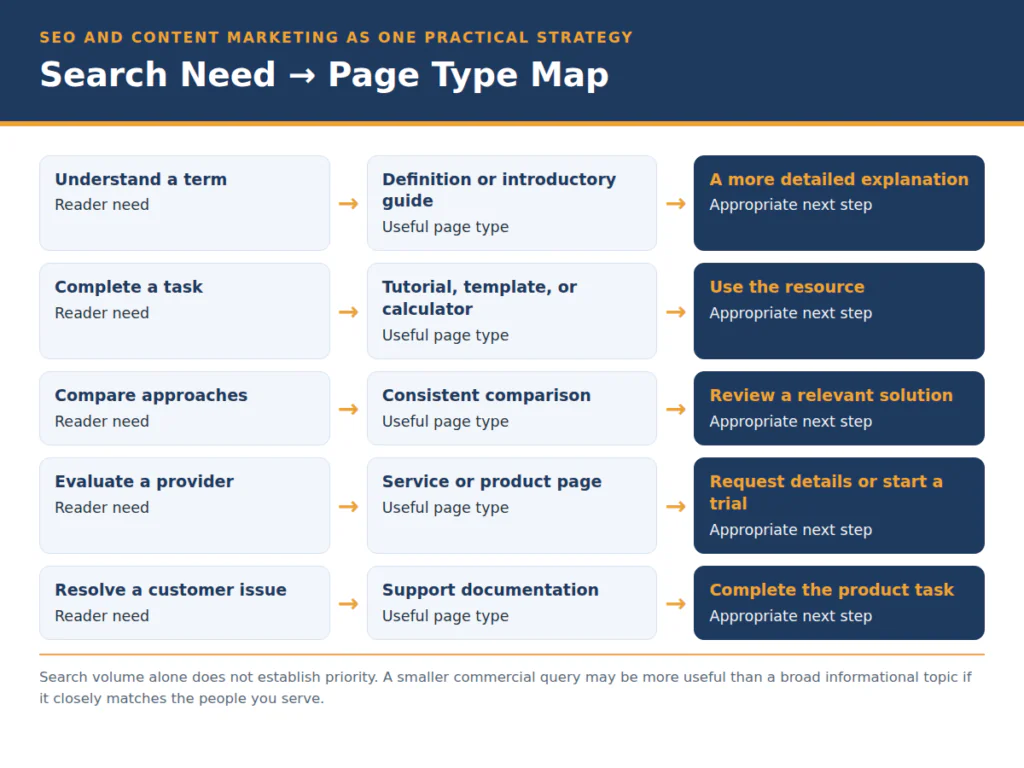
Map search needs to page types
| Reader need | Useful page type | Appropriate next step |
|---|---|---|
| Understand a term | Definition or introductory guide | A more detailed explanation |
| Complete a task | Tutorial, template, or calculator | Use the resource |
| Compare approaches | Consistent comparison | Review a relevant solution |
| Evaluate a provider | Service or product page | Request details or start a trial |
| Resolve a customer issue | Support documentation | Complete the product task |
Search volume alone does not establish priority. A smaller commercial query may be more useful than a broad informational topic if it closely matches the people you serve.
Create a page map
Assign each distinct intent to an existing or proposed URL. Several related keywords can belong to one page. Split topics when the reader needs a different format or decision process.
Review your existing library before creating new content. A strong page needing an example or a technical fix may offer a better opportunity than another article covering the same question.
Record a page owner, evidence needs, internal connections, and review date. This turns a topic list into a production and maintenance plan.
Build content around useful expertise
Interview people who understand the task. Gather original examples, procedures, product details, and limitations. Use external research to verify material facts rather than assembling a collage of competitor summaries.
If the company lacks firsthand evidence, write an honest explanatory guide. Do not invent customer stories or imply testing that did not happen.
For example, a reporting article can include a fictional worksheet with defined inputs and calculations. The reader gains a usable method without being misled about the company’s results.
Make the technical foundation support the content
Important pages need a discoverable route through the website and accessible main content. Check indexing directives, canonical choices, redirects, and the final mobile experience.
A published article is not automatically indexed. Nor does a sitemap replace useful navigation and internal links. Diagnose technical restrictions when a page is not being discovered or understood.
Keep structured data consistent with visible content. Markup should describe the page accurately rather than promising a special ranking benefit.
Connect pages according to the reader’s journey
Link to related explanations where they answer a real follow-up question. A guide can refer to a relevant template, a product page can explain implementation, and a case study can point to the method behind it.
Use descriptive internal anchors that identify the destination. Avoid inserting the same commercial phrase into every paragraph or creating links only to increase a count.
Plan external references separately. Supporting documentation can be linked through contextual, nonfocus anchors while the site’s target keywords remain associated with its own pages.
Distribute beyond search
An article can also supply a newsletter explanation, a short demonstration, a social discussion, or a sales-enablement resource. Adapt the format to the channel rather than posting identical text everywhere.
Distribution can bring useful feedback. Questions from readers and sales conversations may reveal missing steps or terminology that needs explanation. Treat a few comments as qualitative evidence, not a representative survey.
Do not assume that likes or impressions directly establish organic search improvement. Measure the channel’s contribution using appropriate evidence.
Measure a coherent set of outcomes
Track discovery, relevant visits, useful actions, and business results where attribution permits. Keep metric definitions and comparison periods consistent.
A hypothetical guide might gain impressions while clicks remain flat because it appears for more varied queries. Another page might receive fewer visits but more qualified inquiries. Neither pattern can be judged from a single traffic total.
Record other changes, such as pricing, campaigns, and website updates. A simple before-and-after chart does not prove which activity caused the result.
Add AI search evaluation without inventing a formula
Clear definitions, accessible content, accurate product information, and genuine examples help people understand the page. They are a sound foundation for discovery across search interfaces.
If you monitor AI answers, record the engine, prompt, date, and market. Treat the results as a sample. A mention is different from a citation, a visit, or a customer.
Avoid replacing the content strategy with unsupported tactics promising guaranteed recommendations. The practical question remains whether the page answers something important with evidence and clarity.
A manageable planning cycle
Start by auditing existing pages and choosing a small set of priorities. Prepare briefs, collect evidence, publish carefully, and distribute the strongest resources. Review outcomes before expanding production.
Use the review to decide whether to update, merge, promote, or retire a page. A content calendar should create useful work and maintenance capacity, not just new URLs.
For the underlying implementation or measurement guidance, consult the official reference and check current requirements before making changes.
Frequently Asked Questions
Are SEO and content marketing the same
They overlap but have different scopes. SEO includes technical discovery and search presentation; content marketing includes audience education and distribution beyond search.
Which should come first
Begin with the audience and business objective, then research demand and technical constraints together. Do not commission content before knowing its task and place on the site.
Does every article need a commercial CTA
No. The next step should fit the reader’s stage. A useful resource or related explanation may be more appropriate than a sales request.
Will publishing more frequently improve rankings
Frequency alone does not establish usefulness or visibility. Publish at a pace that allows research, review, maintenance, and a distinct purpose for each page.
How should I measure the combined strategy
Connect search discovery with relevant reader actions and business outcomes, while preserving attribution limits and the contribution of other channels.