How to Read an SEO Case Study With Six Examples

An SEO case study is a documented account of a website’s starting situation, changes, measurement period, and observed results. Use it to understand a method and its limits, rather than assuming another site’s percentage increase predicts your own.
The six examples below were published by Google Search Central between 2018 and 2023. They are historical accounts reviewed for this guide, not new 2026 experiments. Their metrics and product context should remain attached to their original dates.
What a useful case study contains
Look for the baseline, affected pages, intervention, implementation period, outcome definition, and source of the measurement. Ask who performed the work and who reported the result.
Separate the observed change from its interpretation. Multiple projects, seasonality, brand demand, and product changes can affect the same period.
A credible account can acknowledge those limits. A precise percentage without the underlying definition may tell you less than a modest result explained carefully.
Example 1 Saramin and sustained technical work
Google’s April 2020 account describes Saramin’s investment in technical improvements, Search Console use, canonical handling, duplicate-content work, and applicable structured data. It reports a 102 percent year-over-year increase in Google organic traffic during the 2019 hiring season, alongside other business metrics.
The useful lesson is the documented sequence of diagnosis, implementation, and review. The result does not isolate one tag or markup change as the cause, and a hiring platform’s seasonal comparison should not become a universal traffic forecast.
Example 2 Rakuten Recipe and search presentation
The May 2018 Rakuten Recipe account discusses its recipe search experience and structured-data work. It reports search-engine traffic increasing 2.7 times and average session duration increasing 1.5 times.
These are different metrics. Do not rewrite the session-duration figure as conversion growth or assume every structured-data implementation receives the same result. The historical tools and presentation described in the account also need checking against current documentation before implementation today.
Example 3 Eventbrite and careful metric wording
Google’s May 2018 Eventbrite account explains wider Event markup implementation and participation in the events search experience. Its reported result concerns roughly a 100 percent increase in the typical year-over-year growth of Google Search traffic to event listing pages in the month after implementation.
That wording is more specific than “traffic doubled.” The account also acknowledges that concurrent SEO projects complicate attribution. Preserve both the metric definition and that limitation when citing the example.
Example 4 Jobrapido and relevant search features
The August 2018 Jobrapido account describes participation in the job experience through job markup. It reports a 182 percent increase in overall organic traffic across countries and a 395 percent increase in new registrations from organic traffic after the experience launched.
The transferable question is whether a relevant search feature and accurate implementation match your own content type. A general service website should not imitate job markup merely because the reported growth is attractive.
Example 5 MX Player and video discoverability
The July 2021 MX Player account describes structured data and regular video-sitemap submission. It reports more than three times the traffic from Google and a 100 percent increase in video page views per user session from organic Search over six months.
The metrics concern a video platform and a defined period. They do not establish a general promise for articles or every embedded video. Review current video-indexing guidance before treating the historical implementation as a present-day checklist.
Example 6 Vimeo and platform level implementation
The January 2023 Vimeo account discusses applying video best practices, VideoObject markup, and embedded-video indexing support so customers did not need to implement every detail independently.
The useful pattern is platform-level work that can improve eligibility across many genuine customer pages. This summary does not attach an invented traffic percentage. It also does not imply that all indexing APIs or historical recommendations apply to ordinary web pages.
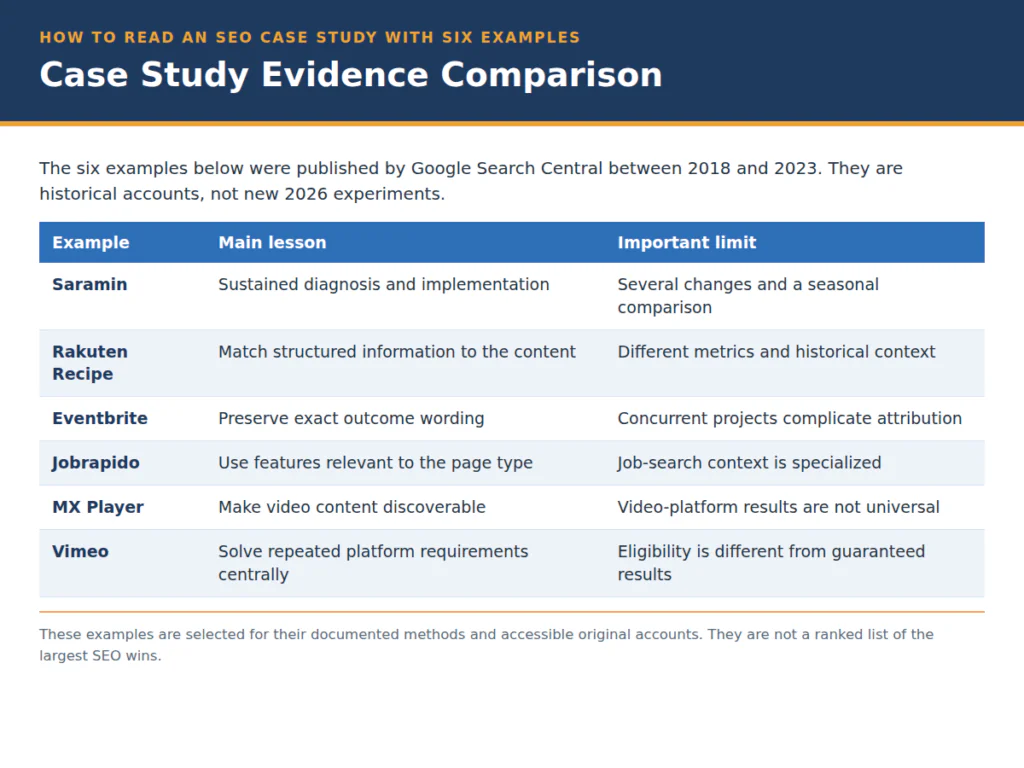
Compare the lessons rather than the percentages
| Example | Main lesson | Important limit |
|---|---|---|
| Saramin | Sustained diagnosis and implementation | Several changes and a seasonal comparison |
| Rakuten Recipe | Match structured information to the content | Different metrics and historical context |
| Eventbrite | Preserve exact outcome wording | Concurrent projects complicate attribution |
| Jobrapido | Use features relevant to the page type | Job-search context is specialized |
| MX Player | Make video content discoverable | Video-platform results are not universal |
| Vimeo | Solve repeated platform requirements centrally | Eligibility is different from guaranteed results |
These examples are selected for their documented methods and accessible original accounts. They are not a ranked list of the largest SEO wins.
Check the arithmetic
If a hypothetical site grows from 100 to 300 visits, it is three times the original level and a 200 percent increase. It is not a 300 percent increase.
If another site grows from 10,000 to 11,000 visits, the percentage increase is smaller but the absolute increase is larger. Baseline size affects how impressive a percentage appears.
Keep units consistent. Clicks, sessions, users, revenue, and registrations cannot be substituted for one another. State whether the comparison is month over month, year over year, or another defined period.
Recognize weak proof
Be cautious when a case study omits dates, baselines, affected pages, implementation details, or attribution limits. A chart can be genuine while its interpretation is overstated.
Ask whether the reported traffic is relevant to the business. Growth in unrelated queries may create little useful demand. Also ask whether a paid campaign, migration, acquisition, or tracking change affected the period.
Do not treat a publisher’s own success account as an independent controlled experiment. It can still be useful evidence when its provenance and limits are clear.
Write your own case study responsibly
Record the starting problem and measurement definitions before implementing changes. Keep a dated change log and note other work that may affect results.
Show a reproducible method, meaningful outcomes, and remaining uncertainty. Obtain client permission and protect confidential information. Use real screenshots and data, not generated dashboards.
If you do not have a real case, publish a labeled demonstration or planning example. It is better to teach a method honestly than to invent a result.
Frequently Asked Questions
What makes an SEO case study trustworthy
A clear baseline, defined changes, dates, metric meanings, evidence, and honest limits. Independent review can strengthen it, but detail still needs inspection.
Are these examples current 2026 tests
No. They are historical published accounts from 2018 to 2023. Check current documentation before implementing their technical details.
Does a traffic increase prove SEO caused it
Not by itself. Other changes and demand can affect the same period. Preserve the study’s attribution limits.
Should I copy a successful site’s tactics
First confirm that the method fits your content type, technical system, and audience. A result from a specialized platform is not a universal blueprint.
Can I create a case study without client data
You can publish an honest demonstration or your own documented project. Do not present fictional figures as a real customer outcome.