SEO Content Writing From Research to Publication

SEO content writing means creating useful content around a real search need and presenting it so readers and search engines can understand it. The work combines audience research, factual explanation, editing, and publication checks. Repeating a keyword is only a small and often overemphasized part of the task.
A successful brief states who the page serves, what question it answers, and what the reader should be able to do afterward. Begin there before choosing a word count or opening a writing tool.
Identify the task behind the query
Searches can ask for an explanation, a comparison, a product, a service, or a way to complete a task. The wording alone does not always settle the intent. Inspect current results and consider the reader’s next decision.
For example, “invoice template” often calls for a usable template, not a long history of invoicing. “How to compare invoice software” needs criteria, trade-offs, and examples. Writing the wrong format well still leaves the reader’s need unmet.
Record a primary intent and any closely related questions the page should answer. Do not combine several unrelated tasks merely because their keywords share a word.
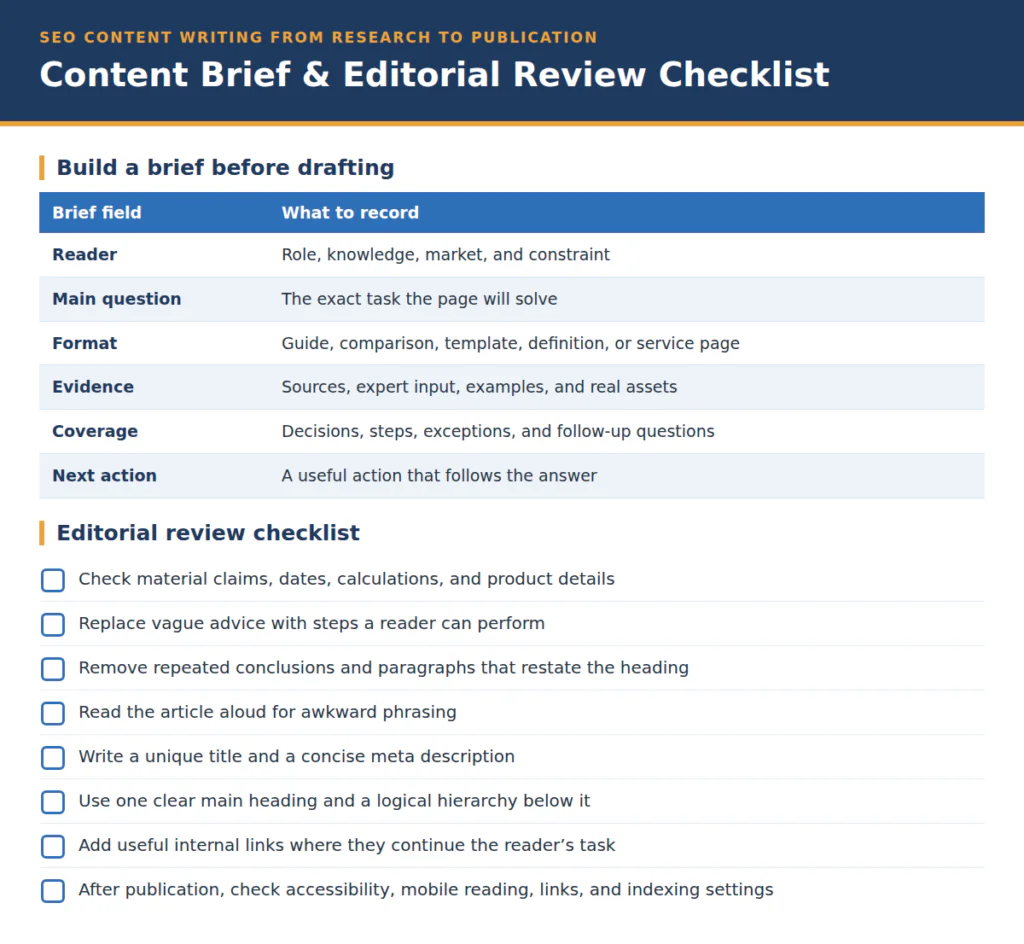
Build a brief before drafting
| Brief field | What to record |
|---|---|
| Reader | Role, knowledge, market, and constraint |
| Main question | The exact task the page will solve |
| Format | Guide, comparison, template, definition, or service page |
| Evidence | Sources, expert input, examples, and real assets |
| Coverage | Decisions, steps, exceptions, and follow-up questions |
| Next action | A useful action that follows the answer |
Also identify what the page will not attempt to cover. A boundary helps the writer explain a subject fully without turning it into an unfocused encyclopedia.
Use keyword research as a map
Choose a primary query cluster and list related terms that explain the subject. Variations often belong on the same page when they share intent. Do not create a new article for every grammatical difference.
Use the primary topic in the title or a natural close variant, the opening explanation, and headings where it fits. Related entities should appear because the explanation needs them. A paragraph about local visibility may naturally mention a business profile, service area, reviews, and contact information.
There is no universal keyword density or entity count that certifies quality. If a term makes a sentence awkward, revise the sentence rather than protecting a quota.
Research without copying the result page
Read competitors to understand the expected task and existing coverage. Then identify what would help a reader more: a worked example, a missing limitation, a comparison with consistent criteria, or a template they can use.
Keep a claim record. Note the source, date, definition, and limits of important facts. Prefer original research and official documentation for product behavior or technical requirements.
A competitor’s statistic is not verified simply because several websites repeat it. Follow it to its original basis. If the underlying evidence cannot be found, remove the number or explain the uncertainty.
Write the answer before the background
Open with the practical answer and the main condition affecting it. Then supply definitions and context where they help the reader continue.
For a tutorial, list prerequisites before steps, show expected outcomes, and address common failure points. For a comparison, use the same criteria for every option. For a service page, explain the actual scope and next step without inventing guarantees.
Headings should describe the questions and decisions in the article. A useful outline remains understandable even when the reader sees only the headings.
Add original value through an example
Suppose a guide teaches monthly reporting. Instead of saying “track important metrics,” show a fictional report with an objective, comparison period, explanation, and next action. State that the numbers are illustrative.
Explain the calculation and the limit. If clicks increase from 400 to 500, that is a 25 percent increase. It does not by itself show an increase in qualified leads. The distinction turns a simple example into useful instruction.
Original value can come from clarity and application. It does not require a fabricated customer story or an unsupported claim of firsthand testing.
Edit for meaning and accuracy
Check material claims, dates, calculations, and product details. Replace vague advice with steps a reader can perform. Remove repeated conclusions and paragraphs that restate the heading without adding information.
Read the article aloud for awkward phrasing. Cut stock introductions and inflated language. A natural tone comes from concrete explanation and varied sentences, not from deliberately adding mistakes.
AI tools can help organize notes or suggest revisions, but the author remains responsible for claims, authorship, and the publication’s policy. Generated references and personal experiences need particular scrutiny.
Prepare the page for publication
Write a unique title and a concise meta description that accurately describe the page. Use one clear main heading and a logical hierarchy below it. Add useful internal links where they continue the reader’s task.
External links should support specific claims or implementation details. Use descriptive supporting anchors, keeping target keywords reserved for your own relevant pages when that is the publishing policy.
Plan images by purpose. Real screenshots demonstrate actual interfaces; designed diagrams explain exact processes; optional AI artwork illustrates a concept. Generated imagery should not impersonate evidence or results.
Review results and improve the page
After publication, check accessibility, mobile reading, links, and indexing settings. Review relevant queries and reader actions over an appropriate period.
Low traffic can have several causes, including weak demand, poor intent fit, technical problems, and competition. Diagnose before adding more words. A longer page is useful only when it answers something important that was missing.
Start your next draft by writing the reader, task, evidence, and practical outcome in four short lines. That brief will improve the work more than a list of phrases to repeat.
For the underlying implementation or measurement guidance, consult the official reference and check current requirements before making changes.
Frequently Asked Questions
How long should SEO content be
Long enough to complete the reader’s task with necessary context and exceptions. There is no universal word count that guarantees rankings.
What is the difference between SEO writing and copywriting
SEO writing often answers search needs and organizes information. Copywriting focuses on persuasion and action. A useful page can require both skills.
Can AI write SEO content
AI can assist, but its output needs factual and editorial review. It cannot supply real experience, tested results, or credentials the author does not have.
How often should I use the focus keyword
Use it naturally where it identifies the page’s subject. Avoid a fixed density target or repetitive headings.
What makes an article feel human
Specific explanations, honest limits, practical examples, and clear decisions. Invented anecdotes and casual filler do not improve authenticity.