Monthly SEO Report Template With Clear Next Actions

A monthly SEO report should explain the business objective, important changes, completed work, unresolved issues, and the next priorities. Keep the main summary short enough for the decision-maker to use, with detailed evidence available separately.
Build the report from consistent definitions and comparison periods. A recurring format is useful only when the underlying data and commentary remain accurate.
Agree on the reporting contract
Define the reader, reporting date, business objective, key metrics, data sources, comparison method, and approval process. Decide what counts as completed work and what requires an escalation outside the monthly cycle.
Clarify whether the deliverable is a fixed document, a live dashboard, or both. Historical documents preserve what was known at the time; live dashboards can change when data or definitions are corrected.
Keep personal information out of routine marketing reports. Use aggregate outcomes and appropriate access, especially for sensitive industries.
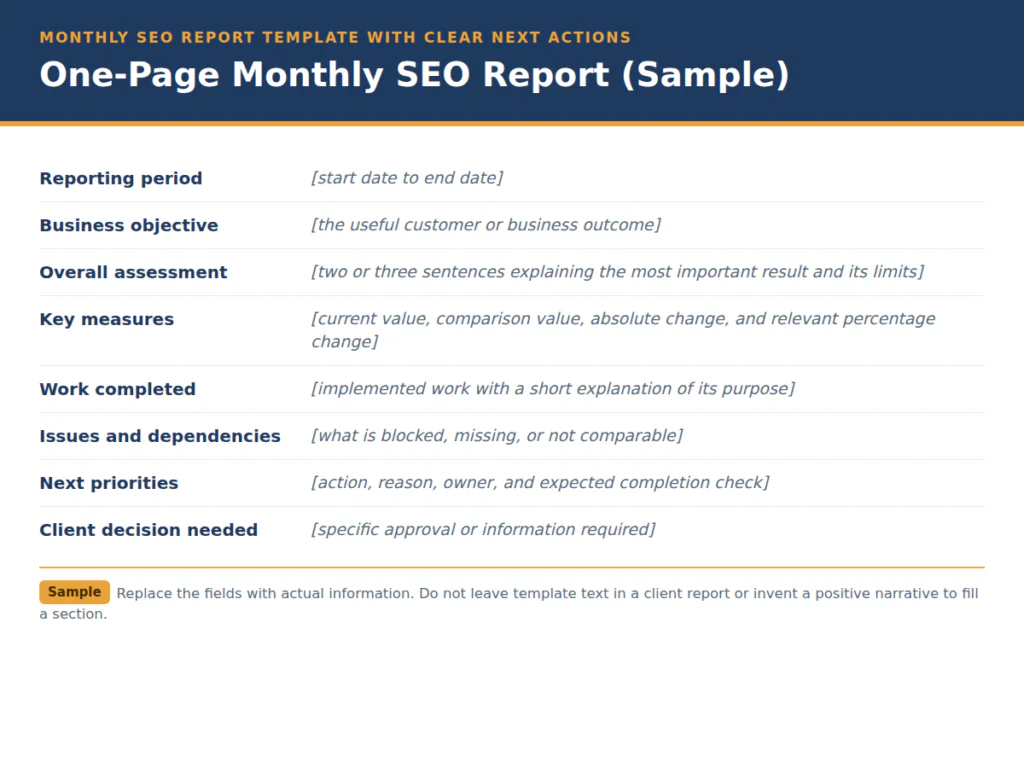
Use this one page summary structure
Reporting period: [start date to end date].
Business objective: [the useful customer or business outcome].
Overall assessment: [two or three sentences explaining the most important result and its limits].
Key measures: [current value, comparison value, absolute change, and relevant percentage change].
Work completed: [implemented work with a short explanation of its purpose].
Issues and dependencies: [what is blocked, missing, or not comparable].
Next priorities: [action, reason, owner, and expected completion check].
Client decision needed: [specific approval or information required].
Replace the fields with actual information. Do not leave template text in a client report or invent a positive narrative to fill a section.
Choose a small set of useful measures
| Measure | Context required |
|---|---|
| Search impressions and clicks | Source, query or page group, and period |
| Relevant organic visits | Analytics definition and tracking limits |
| Qualified outcomes | Business definition and exclusions |
| Important query visibility | Location, device, query set, and method |
| Implementation progress | Delivered, approved, implemented, or blocked |
The right set varies by client. A store, local service company, and SaaS business should not receive identical success definitions merely because the reporting software has a template.
Check comparisons before writing commentary
Match date ranges, time zones, filters, properties, and currencies. Record changes to events, attribution, consent, or source connections.
Use seasonally meaningful comparisons where appropriate. A holiday closure or a change in product availability can affect results independently of search visibility.
If a metric is no longer comparable, say so near the chart. Do not hide the limitation in a general footnote.
A fictional numerical example
Suppose qualified inquiries rise from 20 to 25. The absolute increase is five and the relative increase is 25 percent. If organic visits rise from 1,000 to 1,500, visits increased 50 percent.
Those numbers do not show that lead quality improved or that SEO caused the entire change. They also imply a lower inquiry-per-visit rate under the simplified assumptions, which deserves investigation rather than a purely celebratory summary.
The example uses fictional inputs to demonstrate reporting logic. A real report needs the actual definitions and evidence behind each figure.
Explain a disappointing month
State the result plainly and identify what is known. Review data quality, implementation, demand, competition, page changes, and the conversion path before assigning a cause.
Separate a verified problem from a hypothesis. “The form failed during testing” is evidence. “The form may explain the decline” is an interpretation needing context about timing and affected users.
Recommend a proportionate response. A short-term ranking fluctuation does not automatically justify a sitewide rewrite.
Report work accurately
Use a change log to distinguish recommendations from implementation. If developers have not deployed a fix, describe it as awaiting implementation rather than completed optimization.
For content, record the pages and purpose. An article count alone does not explain whether the work addresses important gaps or duplicates existing coverage.
Keep unresolved dependencies visible with an owner. Repeating the same blocked task every month without an escalation plan is not useful management.
Handle AI visibility separately
If included, document the engines, prompt sample, dates, markets, and observation method. Keep mentions, citations, referrals, and business outcomes distinct.
A change in the prompt set can change an aggregate visibility number. Explain that before comparing months.
Do not describe a few favorable responses as guaranteed AI recommendation coverage. Treat the sample as evidence to interpret with appropriate limits.
Review before distribution
Check the correct client, date ranges, data freshness, access permissions, calculations, commentary, and next actions. Confirm that missing data is not displayed as an unexplained zero.
Assign a reviewer who understands the business objective. Automated assembly can save time, but the final interpretation still needs accountability.
Send the report through the agreed route and use the review to resolve decisions. Keep the approved version with the implementation record.
For the underlying implementation or measurement guidance, consult the official reference and check current requirements before making changes.
Frequently Asked Questions
What should a monthly SEO report include
The objective, period, relevant results, interpretation, completed work, issues, and next actions with owners.
Should I report weekly instead
Use operational updates when needed, but choose the strategic reporting cadence according to the client’s decisions and data volume.
How do I report a tracking change
State what changed, when it changed, and which comparisons are affected. Do not present a broken comparison as a real performance trend.
Can I automate the whole report
Collection and formatting can be automated where reliable. Data checks, interpretation, and final approval still need review.
What is the most useful final section
A short set of justified next actions and the specific decisions or information needed from the client.