SEO for SaaS From Search Intent to Product Demand

SEO for SaaS connects the problems software buyers search for with useful product, comparison, educational, and support pages. Start with the people the product serves and the decisions they make before signing up or speaking to sales.
A content calendar is only part of the work. Technical discovery, product accuracy, internal navigation, and measurement determine whether relevant attention can become useful demand.
Define the buying motion
A self-service product may ask a visitor to start a trial and complete a product task. An enterprise platform may need to support research by several stakeholders before a demonstration or procurement process.
Record the ideal customer, use cases, market, buying objections, and activation or qualification definition. Interview product and sales teams rather than relying entirely on keyword-tool suggestions.
Identify the constraint. Weak product positioning, a broken signup flow, or missing product capabilities cannot be solved by increasing article volume alone.
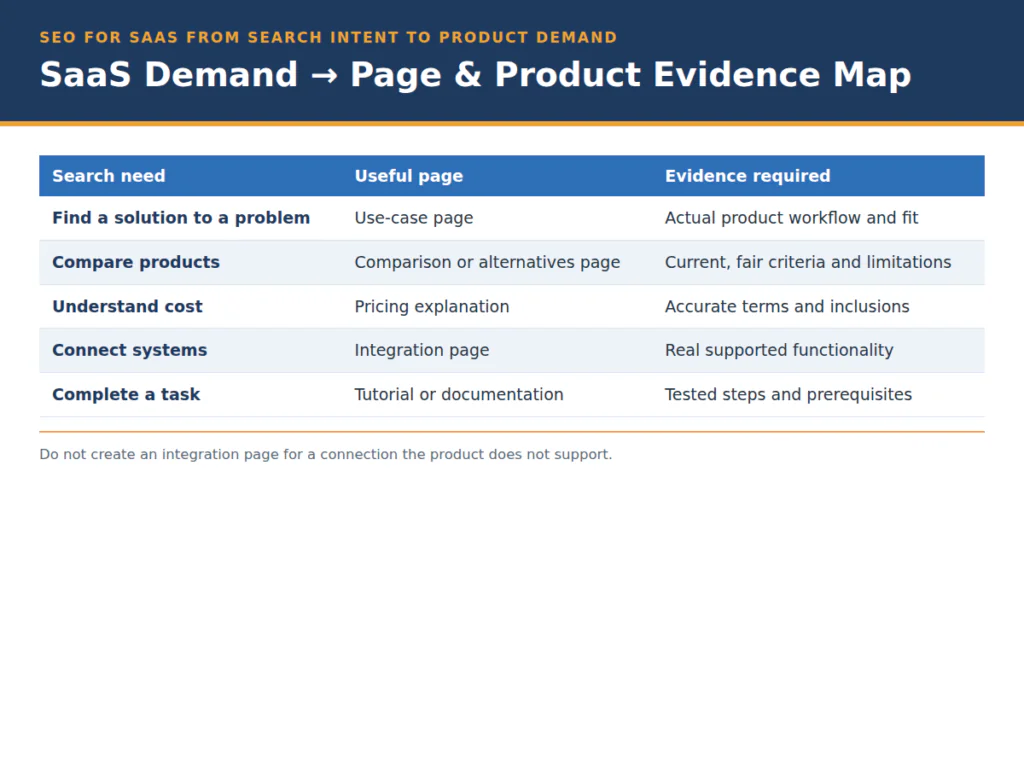
Build a demand map
| Search need | Useful page | Evidence required |
|---|---|---|
| Find a solution to a problem | Use-case page | Actual product workflow and fit |
| Compare products | Comparison or alternatives page | Current, fair criteria and limitations |
| Understand cost | Pricing explanation | Accurate terms and inclusions |
| Connect systems | Integration page | Real supported functionality |
| Complete a task | Tutorial or documentation | Tested steps and prerequisites |
Do not create an integration page for a connection the product does not support. Avoid comparison claims based only on old competitor marketing or untested assumptions.
Prioritize commercial fit without ignoring education
Commercial pages can help people already evaluating a solution. Educational pages can build understanding and support those decisions. Choose the mix according to actual demand and product maturity.
A high-volume topic may attract people who will never need the software. Review the relationship between the query, reader, product use case, and useful next step.
Group close variants by intent. One strong page may cover several phrasings, while a tutorial and a product comparison usually need distinct formats.
Use the product as evidence
Collect real screenshots, workflows, demonstrations, and limitations. Explain prerequisites such as account level, permissions, supported environment, or input requirements when relevant.
Keep product facts current. Give an owner responsibility for checking feature and pricing claims before publication and after material changes.
Do not write a fictional customer success story to create social proof. A labeled demonstration with clear inputs can be useful without pretending it is a customer result.
Make content accessible and connected
Important public pages should be discoverable through navigation and internal links. Review JavaScript rendering, indexing directives, canonical choices, redirects, and duplicate paths where they affect the site.
Distinguish public acquisition pages from private application screens. You do not need every authenticated product state indexed.
Connect use cases, documentation, integrations, and pricing where the reader benefits. The link should help answer a follow-up question rather than merely repeat a commercial anchor.
Evaluate programmatic opportunities carefully
A repeatable template can help when each page contains distinct, useful information. Examples might include genuine integrations, supported data formats, or use cases with different workflows.
A template cannot create missing product value. Hundreds of pages with substituted nouns and identical explanations may add little for users.
Pilot a small set first. Check content accuracy, technical behavior, search intent, and whether users can complete the promised task. Establish update ownership before scaling.
Support AI search with clear product information
Use plain descriptions of what the product does, who it suits, and where it has limitations. Keep comparison criteria and examples understandable without a sales presentation.
If monitoring AI answers, document prompts, engines, dates, and market. Treat the observations as a changing sample. A brand mention is different from a citation, visit, trial, or customer.
Avoid promising that special wording or files will guarantee recommendations. Keep the acquisition plan grounded in useful pages, technical clarity, and genuine evidence.
Define meaningful measurement
Agree on the events that matter: signup, qualified trial, activation, demonstration request, sales-qualified opportunity, or another business-specific action. Document how those events are recorded.
Review branded and nonbranded demand separately where practical. A rise in branded searches may reflect campaigns or company news beyond SEO work.
Track page groups by role. Commercial pages, educational guides, and support articles can serve different purposes, so a single sitewide traffic total can hide useful differences.
Work through a hypothetical example
Imagine a scheduling product that attracts traffic for broad productivity tips but few suitable trials. The team identifies stronger demand around a specific scheduling problem its product actually solves.
It improves the use-case page, adds a tested tutorial, clarifies pricing and limitations, and connects those resources internally. It then reviews qualified trial behavior rather than only the traffic total.
This example illustrates a diagnosis and work plan. It does not claim a measured increase or establish that the same sequence suits every SaaS company.
Build an initial implementation plan
First, validate measurement and repair critical access or conversion problems. Next, improve a small set of high-fit product and use-case pages. Add supporting content where it answers real objections or implementation questions.
Review the results and operational effort before expanding. Keep maintenance capacity for product changes, comparisons, and documentation.
The next useful step is a page map connecting one customer segment, its search questions, the product’s actual capabilities, and a measurable next action.
For the underlying implementation or measurement guidance, consult the official reference and check current requirements before making changes.
Frequently Asked Questions
Should SaaS SEO start with blog posts
Not automatically. Review product, use-case, pricing, comparison, and documentation needs before choosing the publishing mix.
How do I measure SEO beyond traffic
Define qualified signups, trials, activation, demonstrations, or pipeline events with the business. Preserve attribution limits and tracking changes.
Are comparison pages worthwhile
They can help buyers when the criteria are current, fair, and useful. Avoid unsupported claims or outdated competitor details.
Can programmatic SEO work for SaaS
It can when each page has distinct information and a genuine task. Test quality and maintenance before expanding.
Do AI answers replace ordinary search measurement
No. They are another discovery surface to evaluate with a defined method. Mentions and citations should not be reported as equivalent to customers.