Scale by SEO Through Better Demand and Delivery Systems

“Scale by SEO” can describe two different goals: growing a business through search and increasing an SEO team’s delivery capacity. Both require a repeatable process, useful pages, and evidence that the additional work is worth doing.
Choose which problem you are solving. A business short of qualified demand needs a different plan from an agency already selling more work than it can deliver reliably.
Diagnose the limiting factor
For a business, the constraint may be unclear positioning, poor technical access, missing commercial pages, or weak conversion after a visit. For an agency, it may be research, expert input, editing, implementation, or client approvals.
Map the workflow and measure where work waits. A queue of completed drafts awaiting review suggests a different solution from a queue of approved briefs with no writers.
Do not increase production before understanding the bottleneck. More work entering a constrained system can increase delays and corrections rather than useful output.
Grow business demand from a proven page type
Identify a page or topic pattern that serves a real customer need. Examine the search intent, page quality, relevant visits, and downstream actions before treating it as a model.
A useful pattern might be service pages answering distinct buying questions, product comparisons with genuine differences, or tutorials connected to a usable resource. The pattern must remain useful as it expands.
Avoid assuming a successful article can be reproduced by changing a keyword. Each new page needs its own question, evidence, and reason to exist.
Decide what deserves a separate page
| Question | Implication |
|---|---|
| Does the reader need a different decision or format | A separate page may be useful |
| Is the difference only a small wording variation | One page may cover the cluster |
| Can you provide distinct facts or examples | Expansion has a stronger basis |
| Will the page duplicate an existing answer | Update or consolidate first |
| Can you maintain changing information | Set ownership before publishing |
This test is especially important for programmatic pages. A database and template can create URLs quickly, but their value depends on the underlying information and task.
Standardize the work before automating
Document what an acceptable brief, draft, technical ticket, and report contain. Include evidence requirements, review responsibilities, and a definition of completion.
Standardization should reduce avoidable decisions while preserving judgment. A template can require a calculation example; it should not force every article into the same unnecessary sections.
Automation is well suited to organizing approved records, formatting repeated fields, and alerting owners to exceptions. Claims, recommendations, and final publication need review appropriate to the risk.
Calculate production capacity
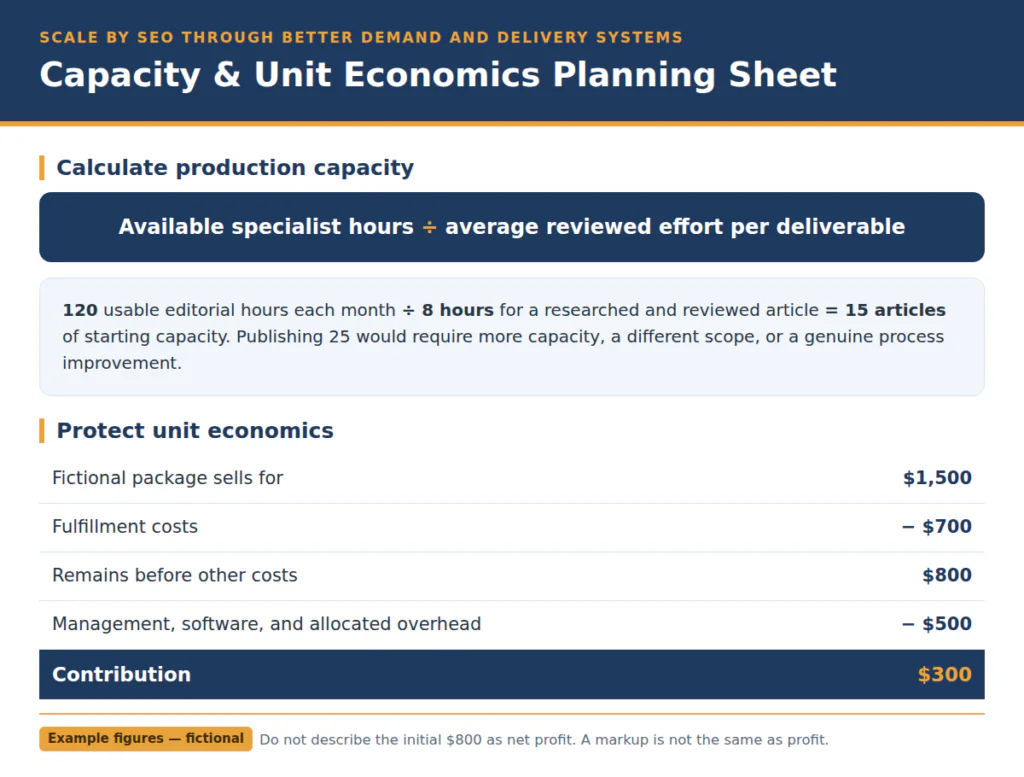
Use a simple planning model: available specialist hours divided by the average reviewed effort per deliverable. Include revisions and coordination, not just initial drafting.
Suppose a fictional team has 120 usable editorial hours each month. If a researched and reviewed article takes eight hours, the starting capacity is 15 articles. Publishing 25 would require more capacity, a different scope, or a genuine process improvement.
The example is not an industry productivity benchmark. Measure your own work and variation. Complex articles and expert reviews may need substantially different effort.
Choose hiring and outsourcing deliberately
Hire or outsource the bottleneck you can define and review. Adding writers will not solve a missing technical implementation owner. Outsourcing technical audits will not help if no one can approve changes.
For a white-label partner, specify deliverables, quality review, account access, confidentiality, escalation, and handover. Your agency remains responsible for the commitments it makes to clients.
Evaluate a pilot before a large contract. Track corrections, missed information, communication, and review effort. A low wholesale fee can become expensive if your team repeatedly repairs the work.
Protect unit economics
Track revenue against fulfillment, account management, software, sales, and overhead. A markup is not the same as profit.
If a fictional package sells for $1,500 and fulfillment costs $700, $800 remains before other costs. If management, software, and allocated overhead total $500, the contribution is $300. Do not describe the initial $800 as net profit.
Compare the economics of actual client types. A small account requiring constant exceptions may consume more capacity than its package name suggests.
Review quality while increasing volume
Sample delivered work and monitor factual corrections, missed requirements, technical regressions, and client complaints. Keep named owners for the final review.
Track whether additional pages serve new needs or compete with existing pages. Consolidate overlap and maintain important resources. Growth creates an update obligation as well as a publishing opportunity.
Avoid mass-producing pages primarily to manipulate rankings. A system should make useful work repeatable, not make unsupported claims easier to publish.
Use a staged expansion plan
First, establish the current bottleneck and baseline. Next, improve one workflow and test a limited increase. Review quality, cost, and business response before adding more volume.
For a business, this may mean expanding one proven service or product page cluster. For an agency, it may mean improving approvals and reporting before accepting more accounts.
Set a stop condition. If errors, delays, or costs rise beyond what the business can support, fix the system before increasing output again.
For the underlying implementation or measurement guidance, consult the official reference and check current requirements before making changes.
Frequently Asked Questions
Is Scale by SEO a standard industry term
The phrase is ambiguous. It can refer to business growth through search or scaling SEO delivery. Confirm whether a searcher means a concept or a particular provider before publishing a brand-specific claim.
Can AI make SEO production unlimited
No. Research, expertise, accuracy, review, implementation, and maintenance remain capacity constraints even when drafting becomes faster.
Should an agency use white label fulfillment to scale
It can help with a defined bottleneck when quality and responsibilities are clear. Outsourcing alone does not guarantee profitable growth.
How many pages should a business add
Base expansion on distinct reader needs, evidence, and maintenance capacity. There is no universal publishing quota.
What metric shows whether scaling is working
Use useful business outcomes alongside quality, delivery time, capacity, and contribution margin. Traffic or output alone is incomplete.