What SEO Means for a Website

SEO means search engine optimization: improving a website so search engines can discover and understand its useful pages, and people can recognize the right result for their needs. It includes content, technical access, navigation, and how pages are presented in search.
SEO does not buy a fixed position. A website can meet technical requirements and still compete with other pages for attention. The practical goal is to make useful information accessible and relevant to the people you serve.
How a page reaches search
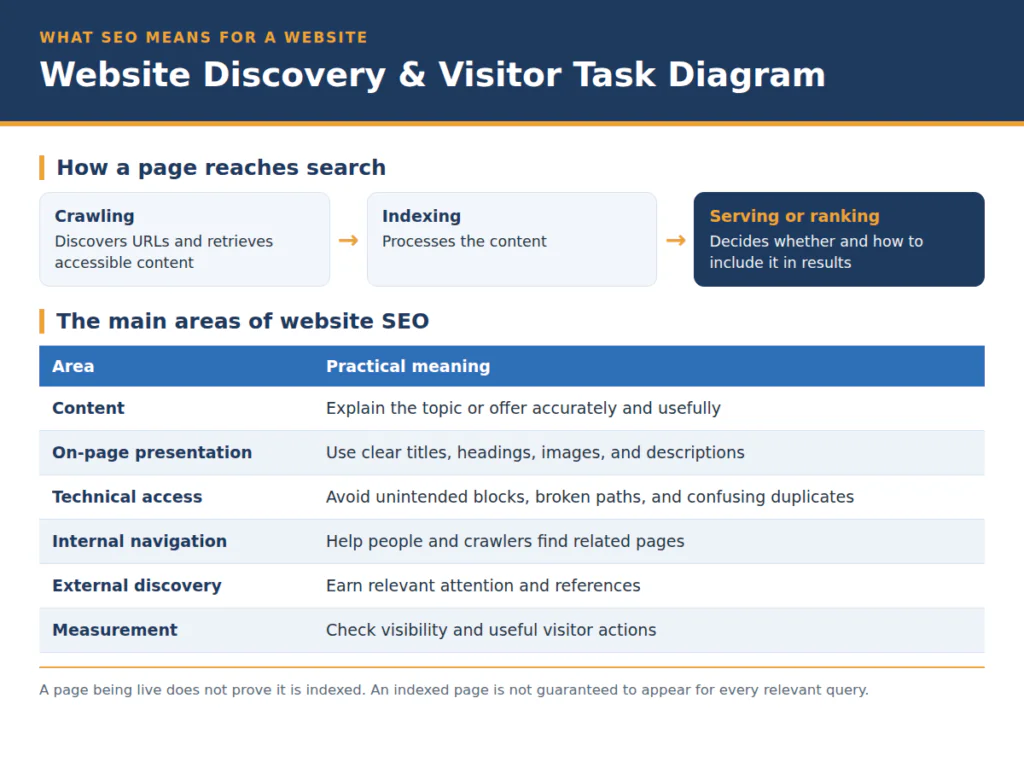
A search engine discovers URLs, retrieves accessible content, processes it, and decides whether and how to include it in results. These stages are often described as crawling, indexing, and serving or ranking.
They are related but different. A page being live does not prove it is indexed. An indexed page is not guaranteed to appear for every relevant query.
For a business owner, the first question is whether important pages can be reached and understood. The next is whether they actually answer the searcher’s task.
The main areas of website SEO
| Area | Practical meaning |
|---|---|
| Content | Explain the topic or offer accurately and usefully |
| On-page presentation | Use clear titles, headings, images, and descriptions |
| Technical access | Avoid unintended blocks, broken paths, and confusing duplicates |
| Internal navigation | Help people and crawlers find related pages |
| External discovery | Earn relevant attention and references |
| Measurement | Check visibility and useful visitor actions |
These areas interact. A strong explanation hidden behind an accidental indexing restriction cannot perform the same job as an accessible page.
Understand search intent
Intent is the task behind the query. Someone asking what a term means wants a clear definition. Someone comparing services wants scope, evidence, and a way to evaluate providers.
Choose a page format that fits the task. A useful calculator should calculate; a product page should explain the product; a service page should make the service and next step clear.
Avoid writing a long article for a query that needs a simple tool or direct answer. Length is useful only when it adds needed explanation.
Use words customers recognize
Describe your product or service using language people actually use. Put the main topic in the title, main heading, opening explanation, and relevant page sections naturally.
You do not need to repeat an exact phrase in every paragraph. Related words help explain the subject when they are used accurately.
For example, a page about a bookkeeping service may need to discuss records, reconciliations, reporting, and responsibilities. Adding unrelated “semantic” terms will not make the service clearer.
Titles and descriptions help explain a result
The HTML title helps describe the page in browsers and can influence its search title link. The main heading introduces the visible page. They should agree in meaning without needing to be identical.
A meta description is a short page summary. Search engines may use page content instead when generating a snippet. Write descriptions for accuracy and usefulness rather than assuming they control every displayed result.
Each important page should have a clear identity. Reusing the same generic title across many pages makes that harder.
Technical checks a beginner can understand
Make sure the website works on mobile and important content is visible without confusing interactions. Check navigation, broken links, redirects, and forms.
Ask your developer to confirm that important pages are not accidentally blocked from indexing. Review canonical settings when several URLs show substantially the same content.
A sitemap can help communicate URLs, but it is not a guarantee of indexing. Keep useful navigation and internal links as part of the site’s ordinary structure.
SEO and paid search differ
Paid search buys advertising placements under a platform’s rules and bidding system. SEO works on the website’s eligibility, relevance, and usefulness for organic discovery.
SEO still has costs: research, writing, development, design, and maintenance. Calling organic traffic “free” can hide the resources required to build and maintain useful pages.
A business may use both approaches. Choose based on the audience, timing, offer, and economics rather than assuming one replaces the other.
Measure more than rankings
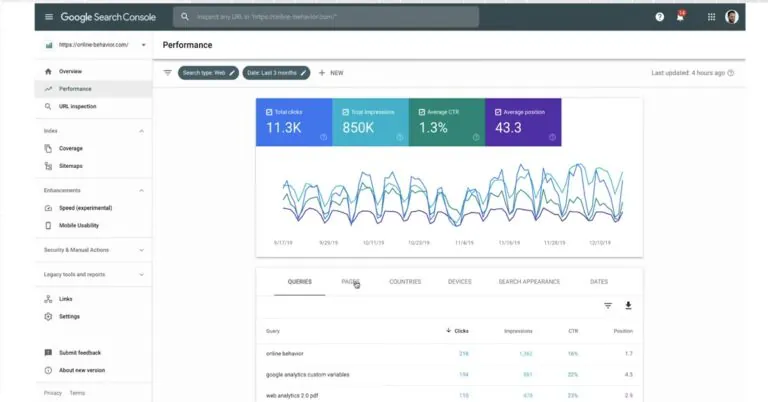
Use first-party search data to understand queries, pages, impressions, and clicks. Analytics and business systems can help show what visitors do afterward, within their measurement limits.
A ranking is an observation for a query and context. Results can differ by location, device, time, and search features. A single manual search is not a complete performance report.
Connect visibility with the business task. A service website needs suitable inquiries; a store needs useful shopping activity; a guide should help readers complete its promised task.
A simple example
Imagine a local repair business whose homepage says only “quality solutions.” Customers cannot tell what it repairs or where it operates.
The business improves its service descriptions, adds truthful coverage and contact details, and fixes a broken mobile form. It also checks technical access and measures suitable inquiries.
Those changes make the site easier to understand and use. Whether traffic or inquiries improve depends on demand and competition as well as the changes themselves. This is an illustrative process, not a reported case study.
What to do first
Choose one important page. Ask whether it clearly answers who it serves, what it provides, and what the visitor should do next. Test that next step on a phone.
Then review the page’s title, navigation, links, and indexing settings. Fix the concrete problems before buying a tool or commissioning a large article calendar.
For the underlying implementation or measurement guidance, consult the official reference and check current requirements before making changes.
Frequently Asked Questions
Does SEO mean adding keywords to a website
Keywords help identify the subject, but SEO also includes useful content, technical access, navigation, presentation, and measurement.
Is SEO a one time task
Some fixes are completed once, while content, products, technical systems, and competition continue to change. Maintenance depends on the site.
Can a website rank without a blog
Yes. Product, service, category, tool, and other useful pages can meet search needs. A blog is one format rather than a universal requirement.
Does SEO guarantee first place
No. Eligibility and good practices do not control every search result or remove competition.
What is the best first SEO step
Make an important page clear, useful, accessible, and easy to act on. Then use evidence to decide the next improvement.