White Label Local SEO and Choosing a Delivery Partner

White label local SEO lets an agency sell local search work under its own brand while another provider supplies some of the delivery. The arrangement can include research, profile work, content, public-record corrections, reporting, or other defined tasks.
A platform and a fulfillment partner are different purchases. Software may organize work; a delivery partner supplies people and processes. Decide which bottleneck you need to solve before requesting a quote.
Define the service you are reselling
Write a scope in terms a client can understand. Identify the business type, locations, services, target market, deliverables, review process, and reporting.
Avoid selling a vague package of “local optimization.” Specify what will be checked, what can be changed, what needs client approval, and what depends on platform eligibility or verification.
Your agency remains responsible for its promises. A supplier’s standard package may need adaptation before it fits your client’s actual business.
Separate software from managed work
| Model | What it can provide | What still needs ownership |
|---|---|---|
| Software platform | Data collection, task organization, reporting | Diagnosis and implementation decisions |
| Managed fulfillment | Defined research and delivery work | Client relationship and final quality control |
| Specialist contractor | A narrow skill or deliverable | Coordination with the rest of the campaign |
| Internal team | Direct delivery control | Hiring, training, capacity, and management |
Some providers combine models. Evaluate the actual contract and team rather than assuming a category describes everything included.
Request an evidence based process
Ask how the partner verifies business information, selects categories, reviews service pages, handles public records, and checks completed changes.
Request a sample action register and report with private information removed. Look for evidence, priorities, owners, and a completion test. A report should distinguish recommendations from implemented work.
Ask what the provider will not do without approval. Changes to business identity, URLs, website content, and account permissions deserve clear control.
Protect account ownership
The client should retain appropriate ownership of its business profile, website, and first-party measurement accounts. Access should be granted according to role and revoked when no longer needed.
Define who receives verification messages, who can add users, and how recovery information is maintained. Avoid a process that leaves the business unable to access its own assets after a contract ends.
Document confidentiality and data sharing. A supplier should receive only the information needed for the work, especially for sensitive clients.
Test quality with a pilot
Choose one representative business rather than the easiest possible account. Provide the same brief and approval requirements you will use at scale.
Review diagnosis, proposed changes, communication, factual accuracy, and delivery evidence. Check the final public pages and profile, not just the supplier’s completion message.
Record how much repair and coordination your agency performs. A low fee can be less attractive when internal review repeatedly becomes rework.
Calculate margin honestly
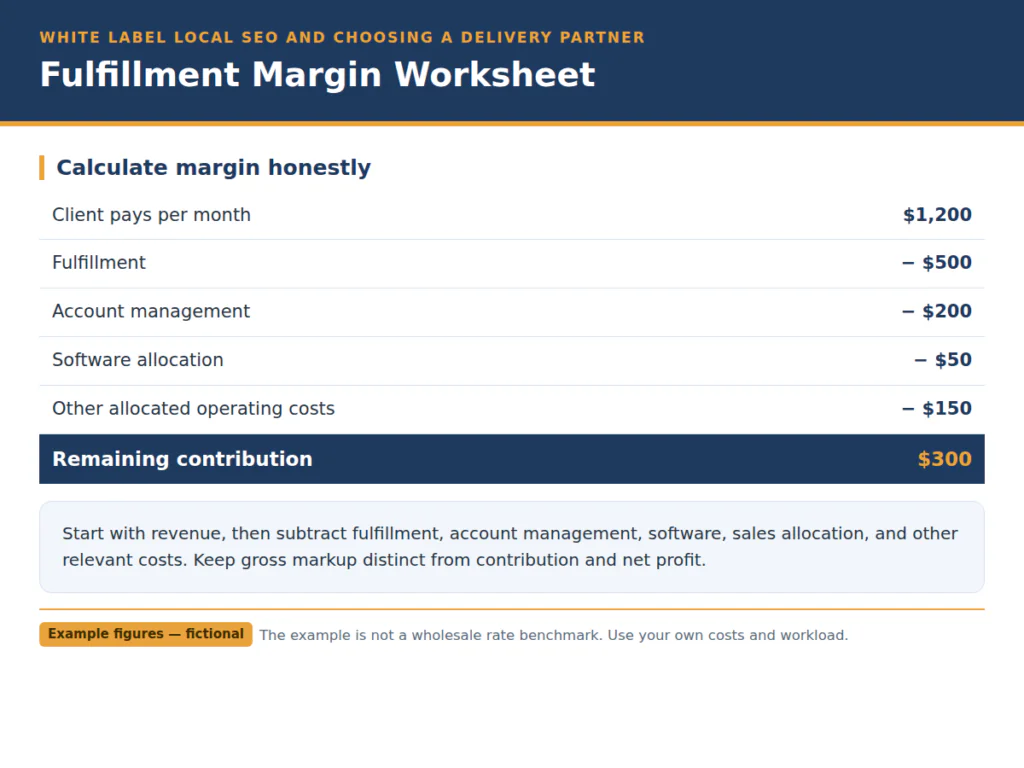
Start with revenue, then subtract fulfillment, account management, software, sales allocation, and other relevant costs. Keep gross markup distinct from contribution and net profit.
Suppose a fictional client pays $1,200 per month. Fulfillment is $500, account management $200, software allocation $50, and other allocated operating costs $150. The remaining contribution under those assumptions is $300.
The example is not a wholesale rate benchmark. Use your own costs and workload. Complex clients and exceptions can change the economics substantially.
Put service levels in writing
Specify response expectations, delivery windows, approvals, revisions, escalation, reporting, substitutions, and handover. Define how urgent incorrect information is handled.
Rankings and lead volume should not be treated as guaranteed delivery items. A supplier can commit to defined work and communication; search visibility and customer response depend on other factors too.
Agree on how platform restrictions and verification delays are reported. A blocked task should remain visibly unresolved rather than being marked complete because a request was submitted.
Review reporting and branding
A white-label report should explain relevant outcomes and actions under your agency’s approved definitions. Branding does not remove responsibility for the data.
Check date ranges, metric sources, missing connections, commentary, and client access. Make sure one client cannot see another’s information through a dashboard or export.
Keep business outcomes separate from tool scores. A higher profile-completeness score is not the same as more suitable calls or bookings.
Plan the exit before onboarding
Confirm what happens to accounts, content, reports, open tasks, and historical data when the relationship ends. Request usable exports and documentation.
Make the client handover independent of an individual supplier employee. A clear record protects continuity when staff, tools, or contracts change.
Review the relationship periodically. Scale only when the partner consistently delivers work that your agency can verify and support profitably.
For the underlying implementation or measurement guidance, consult the official reference and check current requirements before making changes.
Frequently Asked Questions
Is white label local SEO the same as reselling software
No. Reselling a platform provides access or organization; managed fulfillment provides defined work. Some offers combine both.
Who should own the client accounts
The client should retain appropriate owner control, with agency and supplier access limited to their responsibilities.
Can a partner guarantee Maps rankings
It can define work and service levels, but it cannot control every local result or guarantee a fixed ranking outcome.
How do I evaluate wholesale pricing
Compare equivalent scope and include internal review, management, software, and exceptions. A markup alone is not net profit.
What should happen when the contract ends
The agreement should provide a clear handover of access, records, reports, content, and unresolved tasks without trapping the client’s assets.