SEO Services for Ecommerce Websites and Buying Advice

SEO services for ecommerce websites should address the store’s catalog, technical system, product information, customer journey, and measurement. A useful proposal identifies the actual constraints and explains which team will implement the work.
Compare providers on a shared brief. A monthly article quota and a list of broad promises do not establish that a service can handle your store’s platform or commercial needs.
Define the store and the problem
Record the platform, catalog size, markets, languages, product lifecycle, recent changes, and development capacity. Identify whether the issue is discovery, weak product information, duplicate URLs, poor conversion, or unreliable measurement.
Share the business priorities. High revenue does not always mean high contribution, and an agency should not prioritize unavailable or strategically unimportant products simply because the search volume is large.
Keep access appropriate. A provider should understand the store without receiving unrestricted control before responsibilities and permissions are agreed.
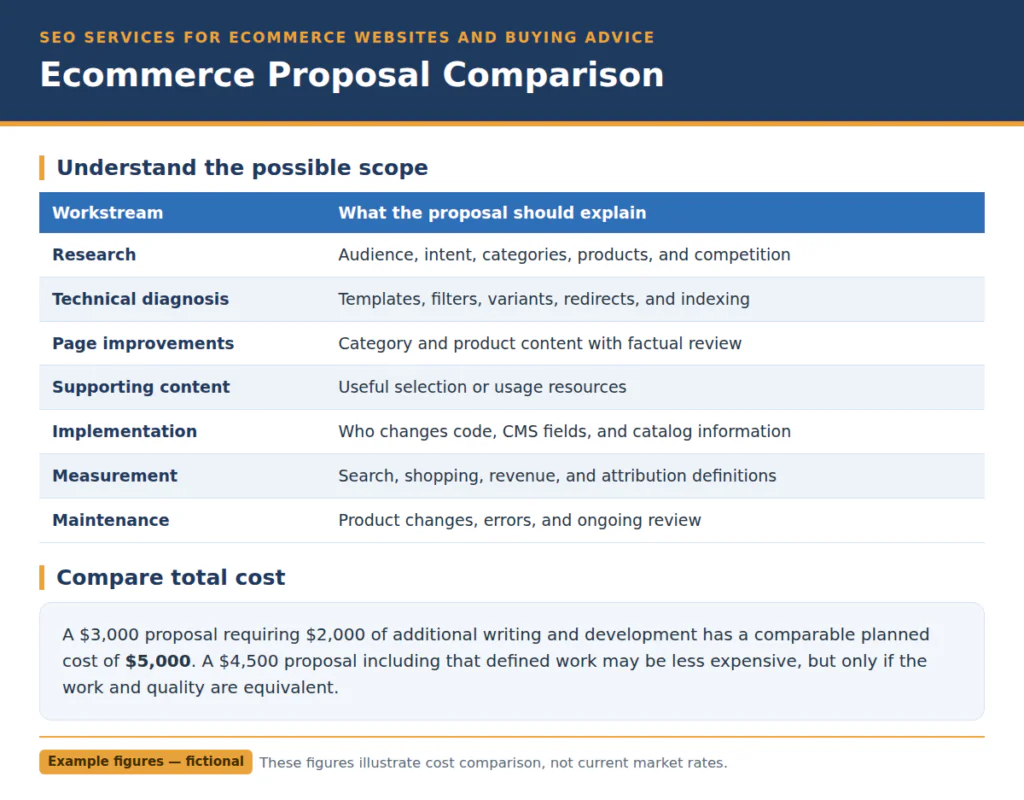
Understand the possible scope
| Workstream | What the proposal should explain |
|---|---|
| Research | Audience, intent, categories, products, and competition |
| Technical diagnosis | Templates, filters, variants, redirects, and indexing |
| Page improvements | Category and product content with factual review |
| Supporting content | Useful selection or usage resources |
| Implementation | Who changes code, CMS fields, and catalog information |
| Measurement | Search, shopping, revenue, and attribution definitions |
| Maintenance | Product changes, errors, and ongoing review |
Not every store needs every workstream immediately. The provider should justify priorities rather than applying the same package to every catalog.
Examine platform experience
Ask for examples of work on a comparable technical setup. Shopify, WooCommerce, and custom storefronts can present different implementation constraints.
A credible specialist should explain how it works with developers, tests templates, handles staging, and checks live changes. A diagnosis without an implementation route can become an unused report.
Do not require an identical product niche if the relevant technical and commercial skills are clear. Ask the provider to explain what transfers and what needs new research.
Evaluate case studies carefully
Look for the baseline, affected pages, changes, period, and metric definitions. Separate revenue from traffic, and observed growth from a causal claim.
Ask whether promotions, stock changes, brand campaigns, migrations, or tracking updates affected the results. A large percentage from a small baseline can sound more impressive than it is.
Where confidentiality prevents full disclosure, request a clear method and appropriately anonymized evidence. Do not accept fabricated specificity or a logo wall as a substitute for an explanation.
Compare total cost
A retainer may exclude development, writing, images, tools, or specialist research. An audit may be a one-time deliverable without implementation support.
Use equivalent scope. In a hypothetical comparison, a $3,000 proposal requiring $2,000 of additional writing and development has a comparable planned cost of $5,000. A $4,500 proposal including that defined work may be less expensive, but only if the work and quality are equivalent.
These figures illustrate cost comparison, not current market rates. Include internal coordination and review effort before judging a quote.
Agree on deliverables and acceptance
Each technical task should identify the issue, affected templates, evidence, proposed fix, owner, and test. Content should have an approved brief, product facts, review, and ownership terms.
Define publication and implementation approvals. A provider should not create large sets of pages, change URL structures, or redirect products without an agreed process.
Keep recommendations, submitted changes, and verified live implementation separate in the report. “Completed” should have a clear meaning.
Review commercial and access terms
Confirm contract duration, notice, cancellation, account access, intellectual property, confidentiality, and handover. The store should retain appropriate ownership of its assets and first-party accounts.
Ask how subcontractors are used and what information they receive. Clarify who is responsible for factual mistakes, technical regressions, and urgent problems.
Be cautious with ranking guarantees or fixed traffic promises. A provider can commit to defined work and communication, but it cannot control demand, competitors, or every search result.
Start with a focused phase
An initial phase might validate measurement, diagnose a critical template, improve selected categories, and test the implementation process. The scope should follow the store’s bottleneck.
Choose a representative part of the catalog rather than an artificially easy example. Review the provider’s communication, evidence, revisions, and business understanding.
Use the first phase to refine priorities. A good service should become more specific as it learns about the store rather than continuing a generic checklist indefinitely.
Measure business outcomes
Review relevant search discovery alongside shopping behavior, orders, revenue, and contribution where available. Keep product availability and promotions visible.
Separate changes in branded demand from nonbranded opportunities where practical. Preserve attribution limits when customers use several channels before buying.
A technically correct project can still have weak commercial results. Diagnose why before expanding spending or blaming a single metric.
For the underlying implementation or measurement guidance, consult the official reference and check current requirements before making changes.
Frequently Asked Questions
What should ecommerce SEO services include
The scope should match the store’s needs and clarify research, technical diagnosis, page work, implementation, measurement, and maintenance responsibilities.
Should I buy an audit or a retainer
An audit can define problems; a retainer may support ongoing implementation and improvement. Choose according to the bottleneck and available internal team.
How much should I spend
Compare current itemized proposals for equivalent work and include development, production, tools, and management. There is no universal appropriate retainer.
Can an agency guarantee sales
No credible general guarantee follows from SEO work alone. Product fit, availability, pricing, conversion, demand, and operations also matter.
What should I ask before signing
Who does the work, who implements it, how changes are approved, what evidence verifies completion, how results are defined, and how the store retains its assets.