How to Choose a SaaS SEO Agency

Choose a SaaS SEO agency by the work your growth model needs, the evidence behind its results, and its ability to connect search activity with qualified demand. A proposal should explain who will do the work, what your team must implement, and how both sides will judge progress.
A product-led company seeking self-service signups needs a different plan from an enterprise platform selling through demonstrations and procurement. Start with that distinction before comparing retainers or agency rankings.
Define the problem you are hiring to solve
Write a short brief covering your ideal customer, product, target market, sales motion, current search visibility, and main constraint. Identify whether the bottleneck is technical accessibility, weak product pages, missing commercial content, slow production, or poor conversion after a visit.
An agency cannot solve an unclear positioning problem simply by publishing more articles. If prospects cannot understand who the product serves, improve that message alongside acquisition work.
Record your internal capacity. A technical audit is useful only when someone can review and implement the changes. An editorial plan needs access to product experts and a person authorized to approve claims.
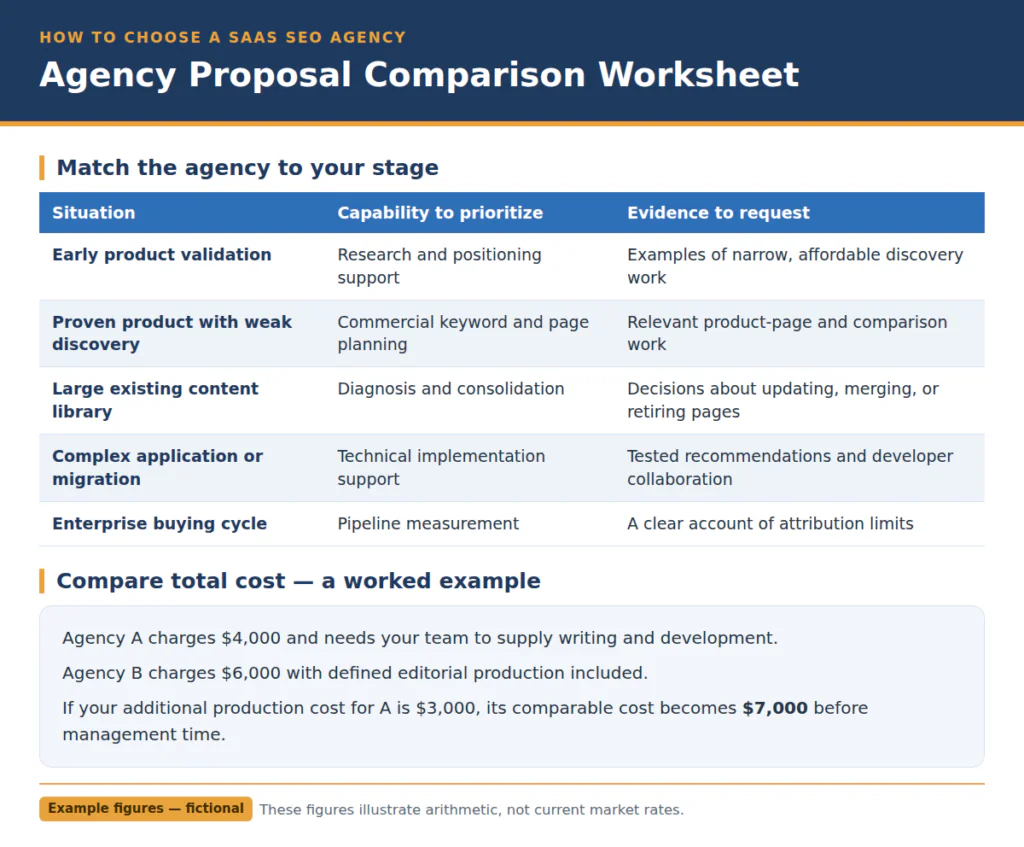
Match the agency to your stage
| Situation | Capability to prioritize | Evidence to request |
|---|---|---|
| Early product validation | Research and positioning support | Examples of narrow, affordable discovery work |
| Proven product with weak discovery | Commercial keyword and page planning | Relevant product-page and comparison work |
| Large existing content library | Diagnosis and consolidation | Decisions about updating, merging, or retiring pages |
| Complex application or migration | Technical implementation support | Tested recommendations and developer collaboration |
| Enterprise buying cycle | Pipeline measurement | A clear account of attribution limits |
Company stage is context, not a universal spending threshold. An established product may still need basic technical work; a small specialist business may already have clear commercial demand.
Examine case studies beyond the headline
Ask what the agency changed, when it changed, and what else happened during the period. A useful case study identifies the baseline, affected pages, implementation responsibilities, and outcome definition.
“Organic traffic doubled” leaves important questions unanswered. Was it branded or nonbranded traffic? Did the audience match the product? Did trial quality improve? Did a migration, new product, or paid campaign affect demand?
Request an example relevant to your sales motion rather than insisting on an identical industry. When client confidentiality limits disclosure, the agency can still explain the method and show appropriately anonymized evidence. Do not treat a logo wall as equivalent proof.
Review the proposed workstreams
A complete scope may include technical research, keyword and intent mapping, product-led content, internal navigation, editorial production, and measurement. It should distinguish discovery from implementation.
For content, ask who interviews subject experts, verifies product claims, creates images, and handles revisions. For technical work, ask who tests changes and checks the results after deployment.
Link acquisition requires its own explanation. Ask how publications are selected and what the commercial arrangement is. A vague promise of a fixed number of high-authority links does not explain audience relevance or policy risk.
Ask how AI search fits the plan
An agency should explain what it can observe and what it cannot attribute. Clear product information, accessible pages, genuine expertise, and useful comparisons serve readers across discovery channels.
If AI-answer monitoring is included, request the prompt set, engines, dates, market, and method. A screenshot of one favorable answer is not a stable visibility measure. Nor does a mention automatically represent a visitor or qualified opportunity.
Evaluate an AI-search service by its defined research and implementation work. Avoid a guarantee that particular edits will secure citations or recommendations.
Compare total cost and responsibilities
Ask for an itemized scope rather than assuming a retainer includes everything. Content, development, design, data tools, and outreach may be separate costs.
Use a hypothetical comparison. Agency A charges $4,000 and needs your team to supply writing and development. Agency B charges $6,000 with defined editorial production included. If your additional production cost for A is $3,000, its comparable cost becomes $7,000 before management time. These figures illustrate arithmetic, not current market rates.
Also check contract length, notice periods, ownership, access, and handover. Your business should retain appropriate control of its website and first-party measurement accounts.
Agree on an initial delivery plan
A proposed first phase might establish measurement, diagnose existing pages, prioritize a few commercial opportunities, and implement a limited test. The sequence should follow your bottleneck rather than a generic monthly article quota.
Ask for acceptance criteria. “Technical optimization” should become a specific issue, proposed change, owner, test, and expected reader or crawler benefit. A content deliverable should include an approved brief, evidence, and review process.
Set review meetings around decisions. Discuss what to continue, what is blocked, and what evidence would justify changing the plan.
Measure business progress honestly
Track relevant search demand, visits to useful product pages, qualified signups or demonstrations, and downstream outcomes where measurement permits. Keep branded and nonbranded patterns visible.
Avoid crediting every conversion touched by search entirely to the agency. Long buying cycles and multiple channels complicate attribution. Agree on useful directional evidence and definitions before the first report.
Your next step is to send the same brief to a small shortlist and compare their proposed diagnosis, responsibilities, and evidence. A precise proposal is easier to evaluate than a broad promise of growth.
For the underlying implementation or measurement guidance, consult the official reference and check current requirements before making changes.
Frequently Asked Questions
How much does a SaaS SEO agency cost
The total depends on research, content, development, market complexity, and delivery scope. Request current itemized quotes rather than applying a universal monthly price.
Should a startup hire an agency or work in house
Choose based on the bottleneck and internal capacity. An agency can supply missing expertise, but someone inside the company still needs to own product knowledge and approvals.
How quickly should results appear
Delivery milestones can be scheduled; search and revenue outcomes vary. Ask what will be learned and implemented early, without accepting a guaranteed ranking deadline.
What should a SaaS SEO proposal include
Audience and product understanding, prioritized work, named responsibilities, evidence requirements, total cost, reporting definitions, and ownership and exit terms.
Is an agency ranking list enough to choose a partner
No. Use lists for discovery, then inspect the methodology, commercial relationships, current capabilities, and fit with your actual brief.